PolyTrack Speedrun Strategies: Advanced Techniques for Record Times
Master speedrunning in PolyTrack with advanced optimization strategies. Learn racing lines, time-saving techniques, and mindset approaches used by world record holders.
PolyTrack Speedrun Strategies: Advanced Techniques for Record Times
The gap between you and the leaderboard? 0.9 seconds. That's not talent—it's technique. Top 1% speedrunners don't have faster reflexes; they have better understanding of racing lines, risk management, and segment optimization. Here's how to join them.
What You'll Learn
This guide reveals the exact strategies used by world record holders to shave seconds off completion times.
Target Audience: Intermediate to Advanced Players
Prerequisites: Track completion ability, basic game mechanics
Time Investment: 30-50+ hours per competitive track
Understanding Speedrun Categories
Time Trial Mode
- Solo optimization, no pressure
- Focus on consistency over single miracle runs
- Most common speedrun format
- Practice-friendly (unlimited attempts)
Competitive Speedruns
- Real-time competition vs other players
- Clutch performance under stress
- Less room for experimentation
- Rewards mental resilience
Segmented vs. Single-Segment
- Segmented: Optimize each section separately, combine best times
- Single-Segment: One continuous start-to-finish run (more prestigious, harder)
Leaderboard Tiers:
- Top 50%: Casual completion
- Top 25%: Basic optimization
- Top 10%: Advanced techniques
- Top 5%: Near-perfect execution
- Top 1%: World record contenders
The Speedrunner's Mindset
Perfection vs. Consistency
🎯 Core Principle: Beginners chase perfect runs. Experts chase consistent runs.
- A 95% run completed > 100% run attempted
- Aim for "good enough" on every section
- Save perfection for final optimization phase (Run 100+)
Why This Works:
- 95% execution = Top 10% times
- 100% execution = Top 1% (but 10× harder to achieve)
- Consistency compounds over 50+ attempts
Failure as Data
Every failed run teaches something:
- Pattern Recognition: Identify repeated mistakes (e.g., "I always oversteer corner 3")
- Skill Limits: Understand current ability ceiling
- New Strategies: Discover alternatives through experimentation
💬 Pro Insight: "I don't count failed runs as failures. Each one is a data point. After 200 runs, I have 200 lessons." - SpeedDemon_Pro
Marathon, Not Sprint
Realistic Expectations:
- Easy tracks: 50-100 attempts for competitive time
- Medium tracks: 200-300 attempts
- Expert tracks: 500-1000+ attempts
- World records: 50-100 hours total investment
Progress is Non-Linear:
- Week 1: Rapid improvement (learning curve)
- Week 2-4: Plateau (muscle memory building)
- Month 2+: Breakthrough moments (new techniques click)
Core Speedrun Techniques
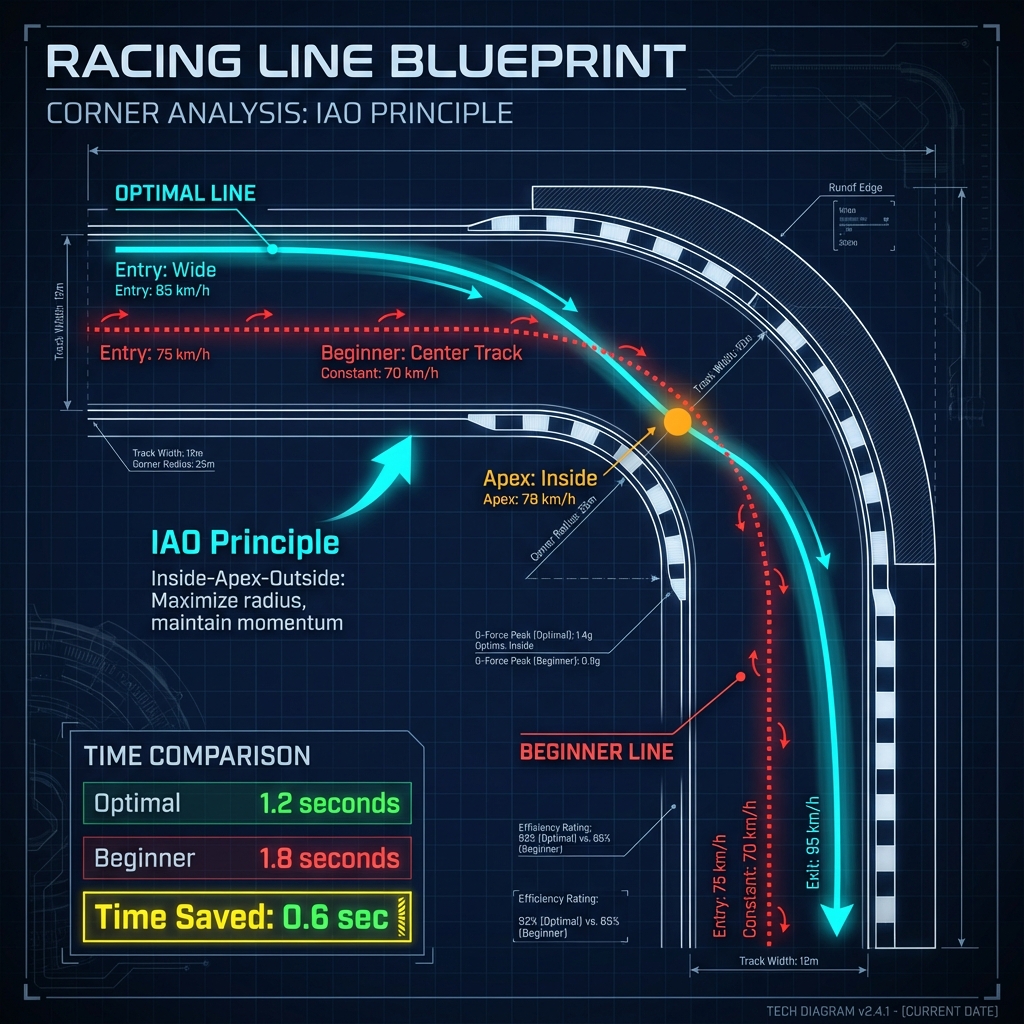
1. Optimal Racing Lines (IAO Principle)
Inside-Apex-Outside:
- Entry: Wide (outside of track)
- Apex: Inside (clip the inner edge at highest safe speed)
- Exit: Wide (straightest line possible)
Quantified Impact:
- Optimal line: 1.2 seconds per corner
- Beginner line: 1.8 seconds per corner
- Time Saved: 0.6 sec/corner × 8 corners = 4.8 sec total
When to Deviate from IAO:
- Boost pad off racing line (calculate: boost gain vs. line loss)
- Next corner setup more important than current
- Track-specific shortcuts exist
💡 Practice Tip: Walk the line mentally before physical execution. Visualization = faster learning.
2. Speed Preservation
Energy Conservation Law: Every km/h lost requires time to regain.
Braking Minimization:
- Brake ONLY when absolutely necessary
- Feather brake (tap) instead of holding (saves 0.1-0.2s per corner)
- Use drift to scrub speed (-15 km/h vs. brake = -30 km/h)
Momentum Management:
- Downhill = free speed (enter at 80% max, exit at 110%)
- Uphill = speed tax (enter as fast as possible)
- Flat = maintain (don't brake, don't waste boost)
Speed Loss Calculations:
- Hard brake: -30 km/h, recovery time 1.5s
- Drift scrub: -15 km/h, recovery time 0.6s
- Savings: 0.9s per corner (×8 = 7.2s total)
3. Boost Pad Optimization
Perfect Alignment = Full Energy Transfer
| Approach Angle | Speed Gain | Energy Efficiency |
|---|---|---|
| 0° (straight) | +35 km/h | 100% ✓ |
| 25° (angled) | +23 km/h | 65% ⚠ |
| 50° (extreme) | +12 km/h | 34% ❌ |
Decision Framework:
- Angle <20° → TAKE IT (worth minor deviation)
- Angle 20-40° → EVALUATE: Is 65% energy worth line sacrifice?
- Angle >40° → SKIP: Maintain optimal racing line instead
Chain Boosting:
- Multiple consecutive pads within 3 seconds
- Compound effect: Pad 1 (+35) → Pad 2 (+35 from higher base) = +70+ total
- Chain multiple pads for maximum effect
Strategic Skipping:
- Sometimes skipping a pad for better line is faster
- Calculate: Time gained from pad vs. time lost deviating from line
- Test both routes, record times
4. Corner Cutting
Advanced technique: taking shortcuts through corners.
Safe Cuts:
- Slight deviation from track edge
- Risk/reward heavily favors reward
- Consistent execution possible
Risky Cuts:
- Major track boundary violations
- High fail rate but huge time save
- Only worth it on final optimization attempts
Track-Specific Strategies
Speedrun Category Tracks
These tracks are designed for time trials:
Characteristics:
- Clean, obstacle-free layouts
- Clear optimal paths
- Fair difficulty curves
Strategy:
- Focus on perfect execution over clever tricks
- Consistency is king
- Study world record runs, copy exact lines
Technical Tracks
Precision-focused tracks with tight corridors:
Characteristics:
- Narrow passages
- Tight corners
- Punishment for mistakes
Strategy:
- Slow is smooth, smooth is fast
- Reduce input aggression (gentle steering)
- Accept that "safe fast" beats "risky faster"
Stunt Tracks
Loop and jump-heavy courses:
Characteristics:
- Vertical elements
- Air time sections
- Physics-dependent segments
Strategy:
- Speed into loops matters more than style
- Land smoothly to preserve momentum
- Study loop entry angles obsessively
Segment Analysis & Optimization
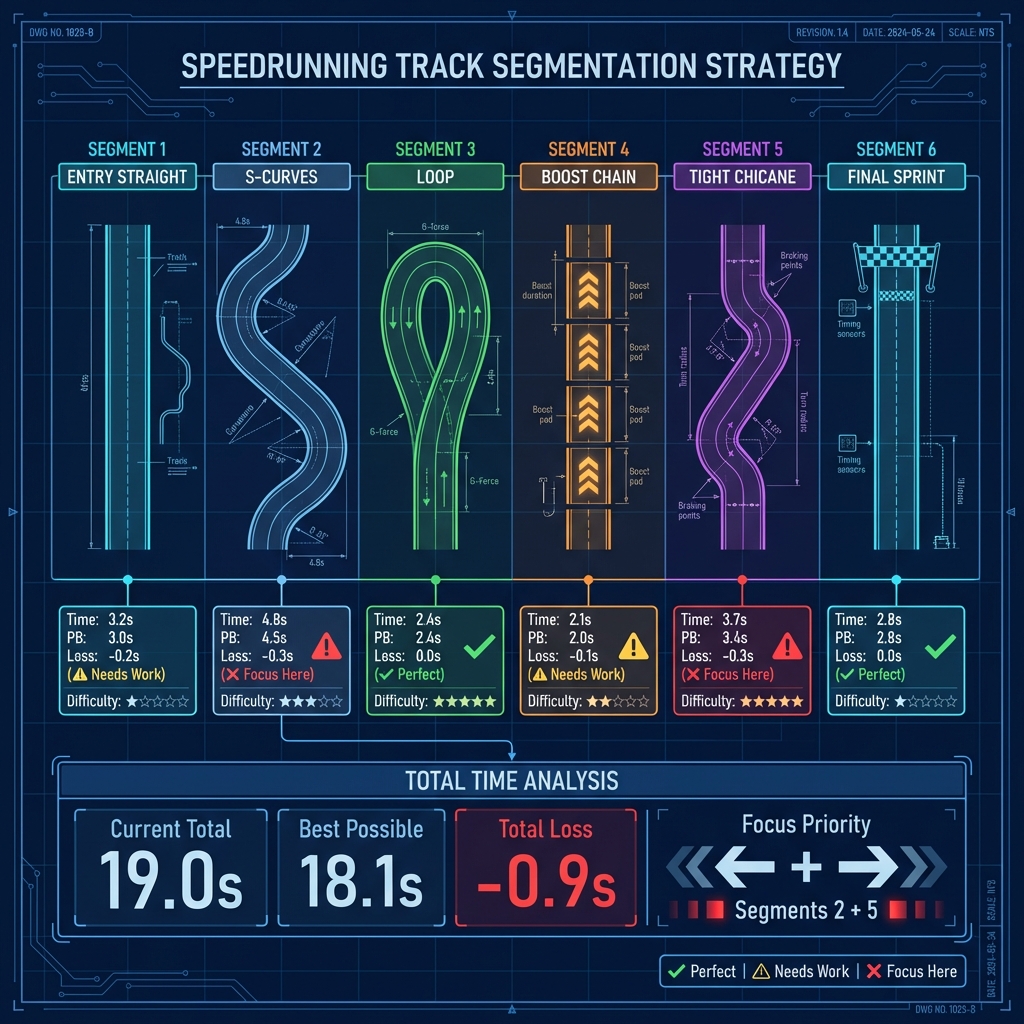
Break Track into 5-10 Segments
Example Analysis (see diagram):
- Segment 1 (Entry Straight): 3.2s | PB: 3.0s | Loss: -0.2s ⚠
- Segment 2 (S-Curves): 4.8s | PB: 4.5s | Loss: -0.3s ❌ FOCUS
- Segment 3 (Loop): 2.4s | PB: 2.4s | Loss: 0.0s ✓ Perfect
- Segment 4 (Boost Chain): 2.1s | PB: 2.0s | Loss: -0.1s ⚠
- Segment 5 (Tight Chicane): 3.7s | PB: 3.4s | Loss: -0.3s ❌ FOCUS
- Segment 6 (Final Sprint): 2.8s | PB: 2.8s | Loss: 0.0s ✓
Total: 19.0s | Best Possible: 18.1s | 0.9s to save
Optimization Strategy:
- Identify weakest segments (most time loss) → Segments 2 + 5
- Practice those segments in isolation (20-30 reps each)
- Combine optimized segments in full runs
- Repeat until all segments at PB level
80/20 Rule: 80% of time loss comes from 20% of segments. Focus there first.
Video Review
Record runs for analysis:
What to Look For:
- Subtle steering mistakes
- Brake usage frequency
- Boost pad alignment
- Unintentional collisions
Comparison:
- Compare your run to world record (side-by-side if possible)
- Note differences in lines, speeds, techniques
- Implement one difference at a time
Input Buffering (Advanced)
- Pre-press next input slightly before needed
- Game buffers input, executes on next valid frame
- Crucial for quick direction changes
Risk Management Across Race Zones
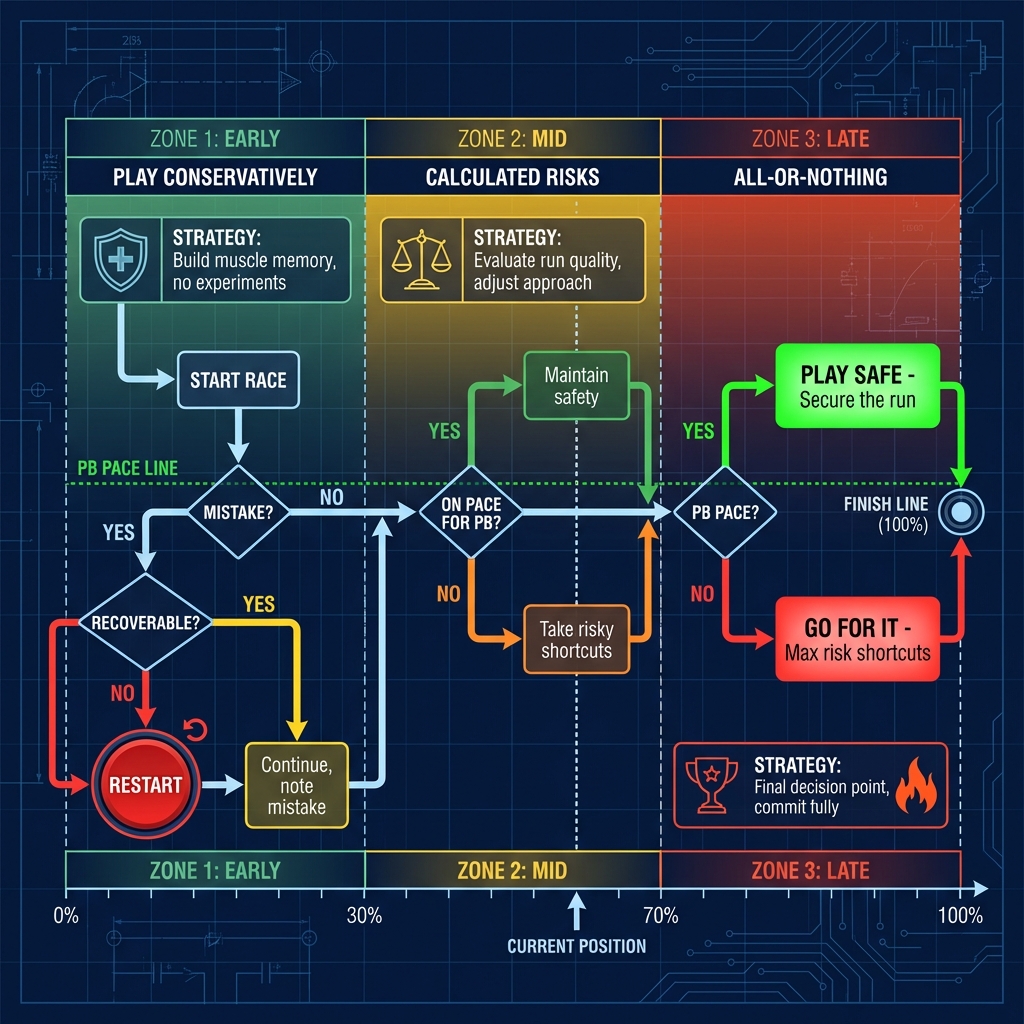
Zone 1: EARLY (0-30% of track) - Play Conservatively
Strategy: Build muscle memory, no experiments
Decision Tree:
- Mistake? → Recoverable?
- NO → RESTART immediately (don't waste time)
- YES → Continue, note mistake for analysis
Rationale: Early mistakes compound. If you're 0.5s behind at 30%, you need risky plays later to recover.
Zone 2: MID (30-70% of track) - Calculated Risks
Strategy: Evaluate run quality, adjust approach
Decision Tree:
- On pace for PB?
- YES → Maintain safety (secure the run)
- NO → Take risky shortcuts (need to make up time)
Rationale: Mid-run is decision point. Good run = protect it. Bad run = experiment.
Zone 3: LATE (70-100% of track) - All-or-Nothing
Strategy: Final commitment
Decision Tree:
- PB pace?
- YES → PLAY SAFE - Secure the run (no unnecessary risks)
- NO → GO FOR IT - Max risk shortcuts (last chance)
Rationale: With 30% left, your trajectory is clear. Either protect PB or go for broke.
Common Speedrun Mistakes
Mistake #1: Not Practicing Individual Sections
Symptom: Inconsistent times across runs.
Fix: Practice difficult sections in isolation until muscle memory develops.
Mistake #2: Giving Up Too Early on Runs
Symptom: Constantly restarting, never finishing runs.
Fix: Set rule - "Complete every run unless >2 seconds behind pace."
Mistake #3: Ignoring Mental Fatigue
Symptom: Performance degrades after long sessions.
Fix: Take 10-minute break every 30-45 minutes.
Mistake #4: No Benchmark Times
Symptom: Don't know if you're improving.
Fix: Record segment times, track PBs, set incremental goals.
Building a Speedrun Strategy
Step 1: Reconnaissance (First 10 Runs)
Goal: Learn the track thoroughly
- Complete track safely 10 times
- Identify all checkpoints
- Note boost pad locations
- Find obvious shortcuts
Step 2: Route Planning (Runs 11-25)
Goal: Establish optimal route
- Experiment with different lines
- Test risky shortcuts
- Compare completion times
- Choose consistent route
Step 3: Execution Practice (Runs 26-100)
Goal: Build muscle memory
- Repeat chosen route consistently
- Focus on smoothness
- Reduce mistakes
- Set initial PB times
Step 4: Optimization (Runs 101+)
Goal: Shave seconds
- Micro-optimizations per segment
- Test alternative approaches
- Study world record runs
- Push boundaries cautiously
Equipment & Setup
Control Configuration
- Keyboard vs. gamepad: Neither is objectively better
- Consistency matters more than equipment
- Muscle memory specific to your setup
Display Settings
- Higher FPS = better reaction times
- Lower graphics if performance issues
- Consistent framerate > pretty visuals
Recording Setup
- Screen recording for review
- Don't obsess over production quality
- Simple OBS setup sufficient
Competing for Leaderboards
Submitting Times:
When you achieve a competitive time:
- Record the run (required for verification)
- Note exact completion time
- Share on community forums (r/polytrack)
- Submit to leaderboard trackers if available
Handling Pressure:
Competition nerves are real:
- Practice "pressure runs" - imagine competing while solo
- Deep breathing before attempts
- Accept that first attempt won't be your best
Track Recommendations for Speedrunning
Beginner Speedrun Tracks:
- Clean layouts, forgiving mistakes
- Browse Speedrun category - Easy difficulty
Intermediate Tracks:
- Require advanced techniques
- Speedrun category - Medium/Hard
Expert Challenges:
- World record competition active
- Speedrun category - Expert/Impossible
Speedrun Community
Learning Resources:
- Watch top runners on YouTube
- Join r/polytrack for strategy discussions
- Share your runs, get feedback
Finding Rivals:
- Friendly competition accelerates improvement
- Compare times with friends
- Establish friendly leaderboards
The Path to World Records
Realistic Timeline:
- Week 1: Learn track, establish baseline
- Week 2-4: Consistent sub-PB times
- Month 2-3: Reach genuinely competitive times
- Month 4-6: Compete for top spots
- Month 6+: World record attempts
When to Move On:
Don't grind one track forever:
- Set a specific target time to aim for
- Achieve it, then move to new track
- Return later for final optimization
Mindset for Long-Term Success
Embrace the Grind: Speedrunning is repetitive by nature. Find joy in incremental improvement.
Celebrate Small Wins:
- New PB by 0.1 seconds? Celebrate it.
- Nail a difficult section? That's progress.
- Failed run but learned something? Still valuable.
Know When to Stop:
- Frustration = time to quit for the day
- Forcing it leads to bad habits
- Tomorrow's fresh mind > tonight's tired grind
Speedrun Checklist
Before every session:
- Choose specific track and goal time
- Warm up with 2-3 casual runs
- Review previous best run
- Set realistic session goal (e.g., "Beat PB once")
- Track progress in spreadsheet/notes
After every session:
- Record new PB if achieved
- Note what worked well
- Identify specific areas for next session
- Rest before next attempt
Final Wisdom
The best speedrunners share these traits:
- Patience - Improvement is non-linear
- Analytical mindset - Treat runs as data
- Consistency - Regular practice beats marathon sessions
- Community - Learn from others, share knowledge
Speedrunning PolyTrack is a journey of constant improvement. Your first world record will taste sweet because of the hundreds of hours invested. Start small, stay consistent, and enjoy the chase.
Ready to start speedrunning? Browse our Speedrun tracks or check out Drift Techniques for complementary skills!